Voice-First Note Taking: A 0→1 Case Study
Voice-First Note Taking: A 0→1 Case Study
Voice-First Note Taking: A 0→1 Case Study
Brain Dump is a voice-first notes app for capturing unstructured thoughts. I took it from 0 → 1, owning problem definition, scope decisions, design, and distribution and validating the idea with real users.
Company
Brain Dump
Year
Present
Role
Designer | PM | Content Marketer
Problems & Key Decisions
What problem to solve first
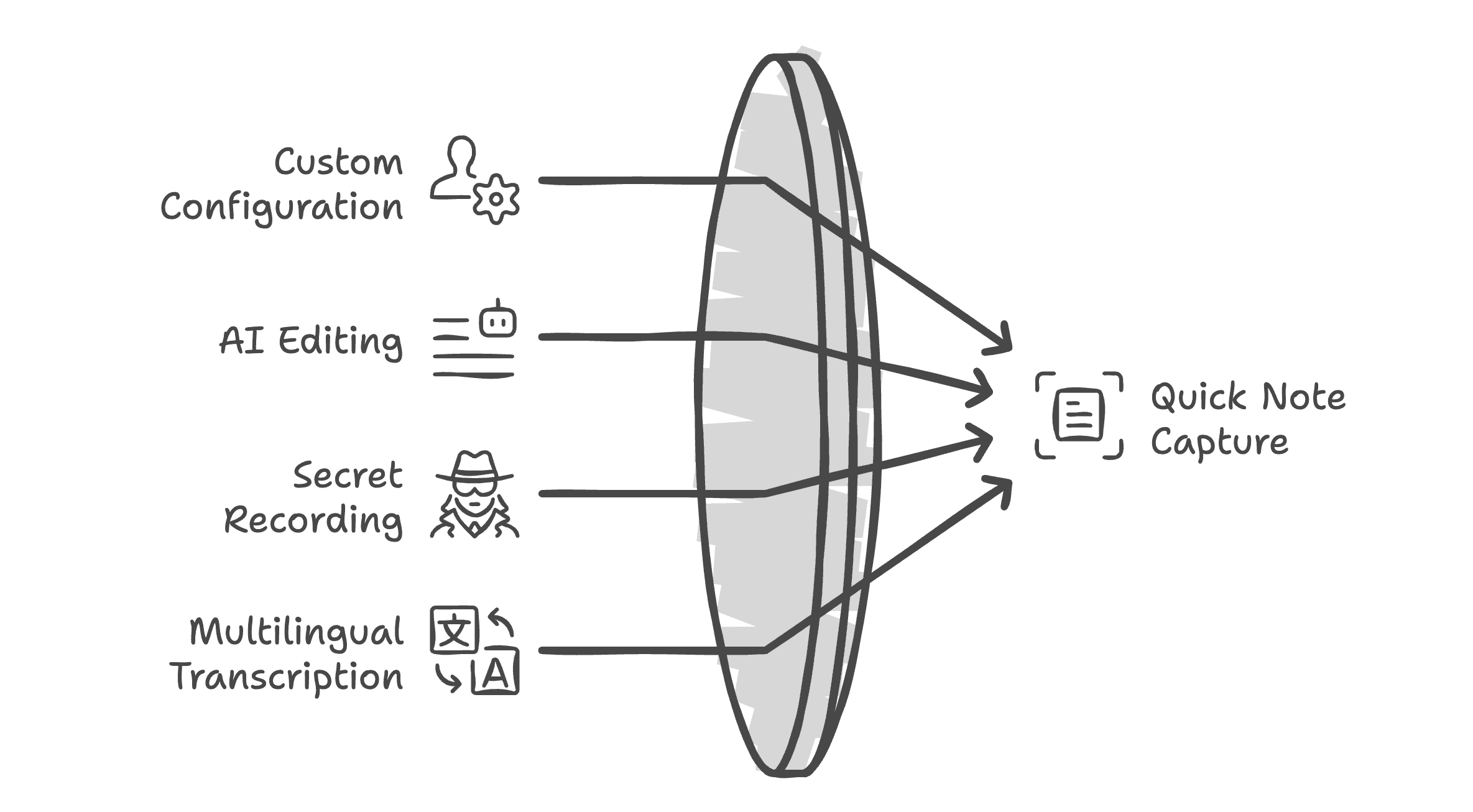
Early on, the product was reduced to its most fundamental job: reliably capturing thoughts. In a voice-first context, failure at capture invalidates everything downstream—organisation, editing, and retrieval only matter if ideas are recorded cleanly and without friction. The MVP therefore focused on voice capture and basic note creation.
What problem to solve first
Early on, the product was reduced to its most fundamental job: reliably capturing thoughts. In a voice-first context, failure at capture invalidates everything downstream—organisation, editing, and retrieval only matter if ideas are recorded cleanly and without friction. The MVP therefore focused on voice capture and basic note creation.
What not to build
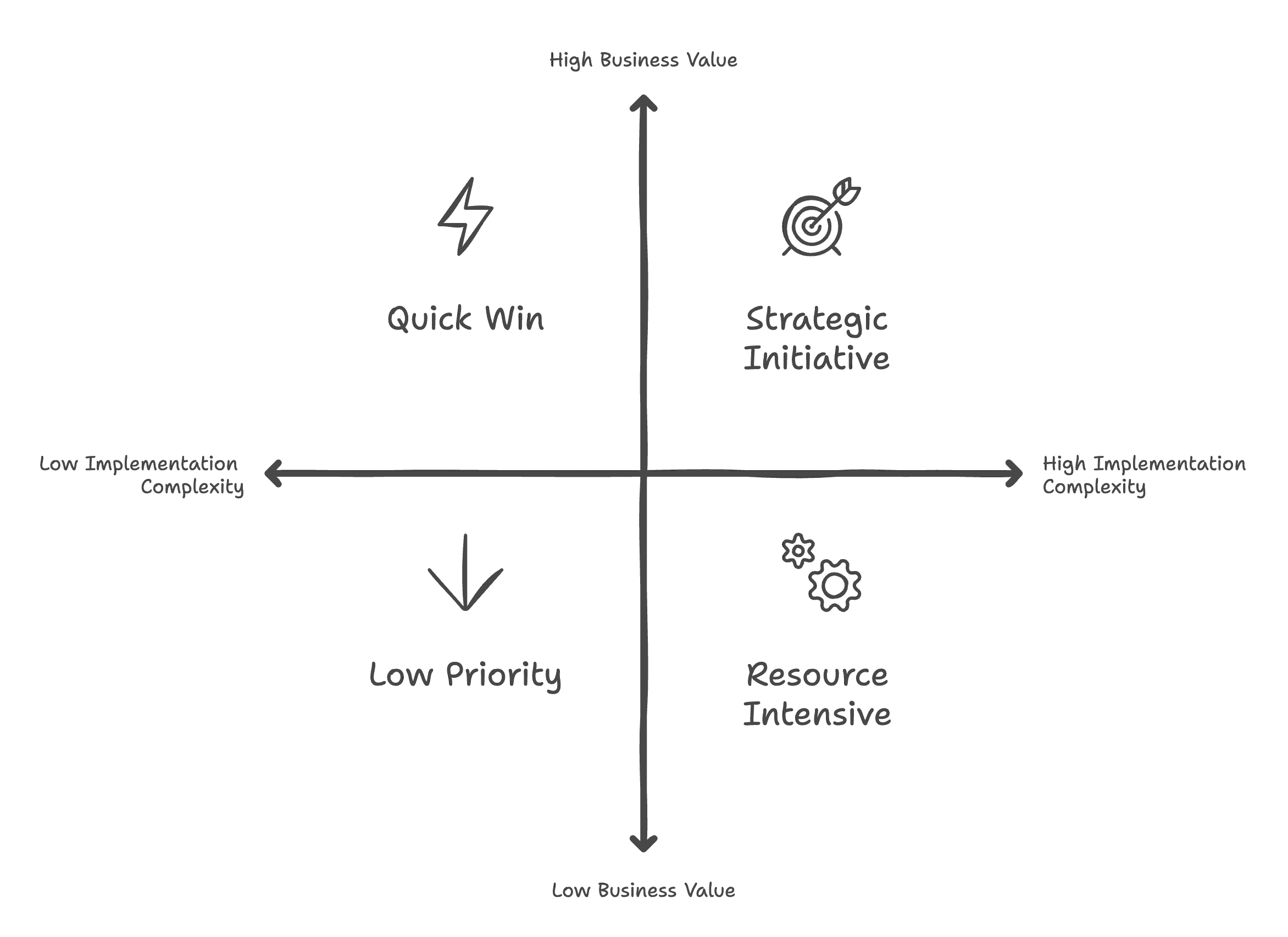
Features such as advanced organisation, tagging, and multi-note workflows were intentionally excluded from V1. These added complexity without strengthening the core capture experience and would have slowed iteration under uncertainty. However, future versions were considered in the design to ensure the product could evolve without rework once the core workflows were proven.
What not to build
Features such as advanced organisation, tagging, and multi-note workflows were intentionally excluded from V1. These added complexity without strengthening the core capture experience and would have slowed iteration under uncertainty. However, future versions were considered in the design to ensure the product could evolve without rework once the core workflows were proven.
How to validate without paid acquisition
With no budget for paid acquisition, validation depended on fast exposure and feedback. A build-in-public approach using short-form content allowed the product to reach real users early, creating a tight feedback loop between usage, design decisions, and iteration. This ensured that scope decisions were informed by observed behavior rather than assumptions.
How to validate without paid acquisition
With no budget for paid acquisition, validation depended on fast exposure and feedback. A build-in-public approach using short-form content allowed the product to reach real users early, creating a tight feedback loop between usage, design decisions, and iteration. This ensured that scope decisions were informed by observed behavior rather than assumptions.
Constraints & Limitations
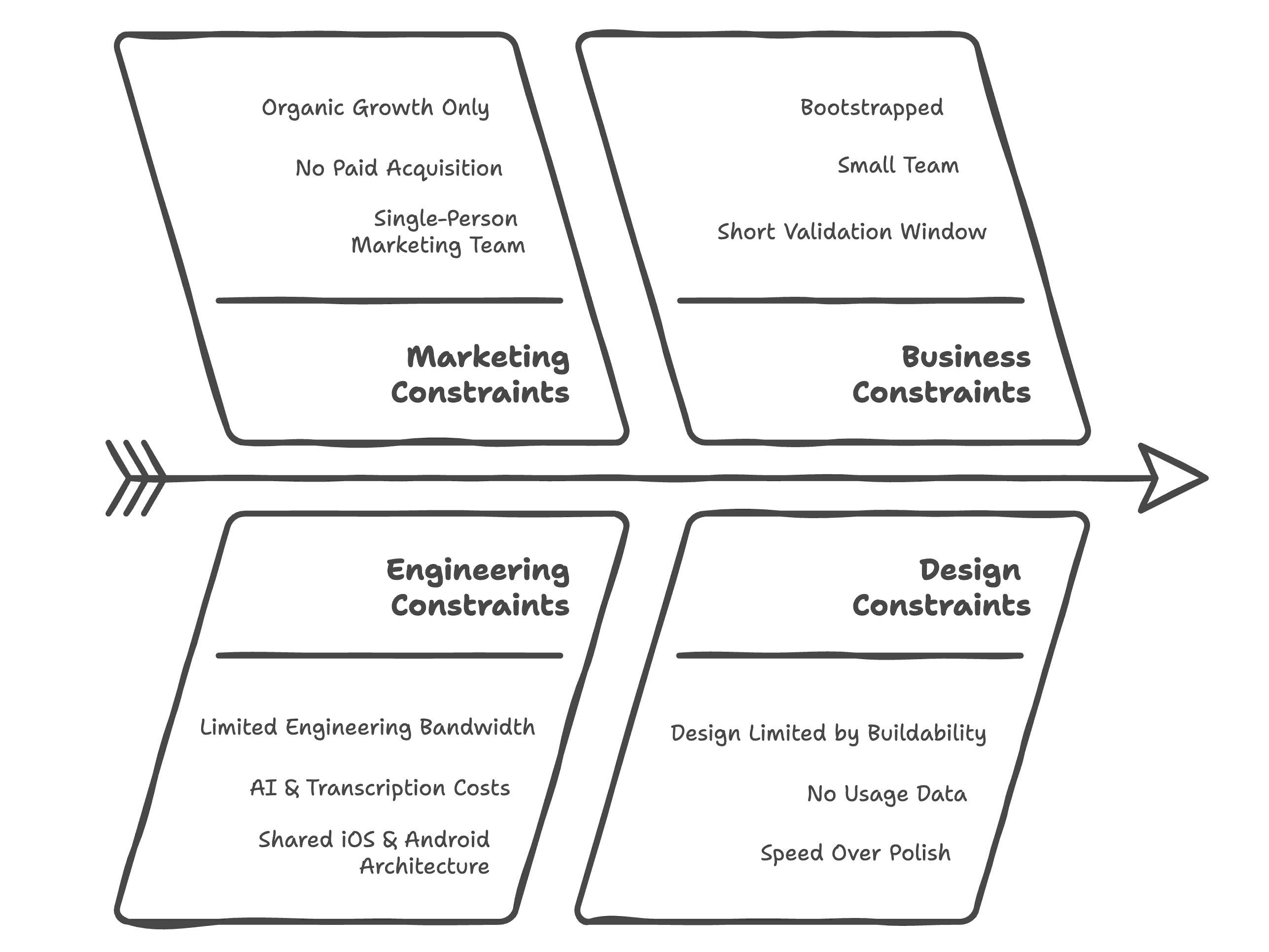
Unvalidated demand, limited engineering bandwidth, and cross-platform requirements shaped every decision. These constraints enforced a bias toward simple, buildable solutions that minimized cognitive load and interaction cost. Rather than designing for scale upfront, the product was designed to learn quickly, with systems and interfaces that could remain stable as complexity increased later.
Constraints & Limitations
Unvalidated demand, limited engineering bandwidth, and cross-platform requirements shaped every decision. These constraints enforced a bias toward simple, buildable solutions that minimized cognitive load and interaction cost. Rather than designing for scale upfront, the product was designed to learn quickly, with systems and interfaces that could remain stable as complexity increased later.
Solution
A single surface for capture and refinement
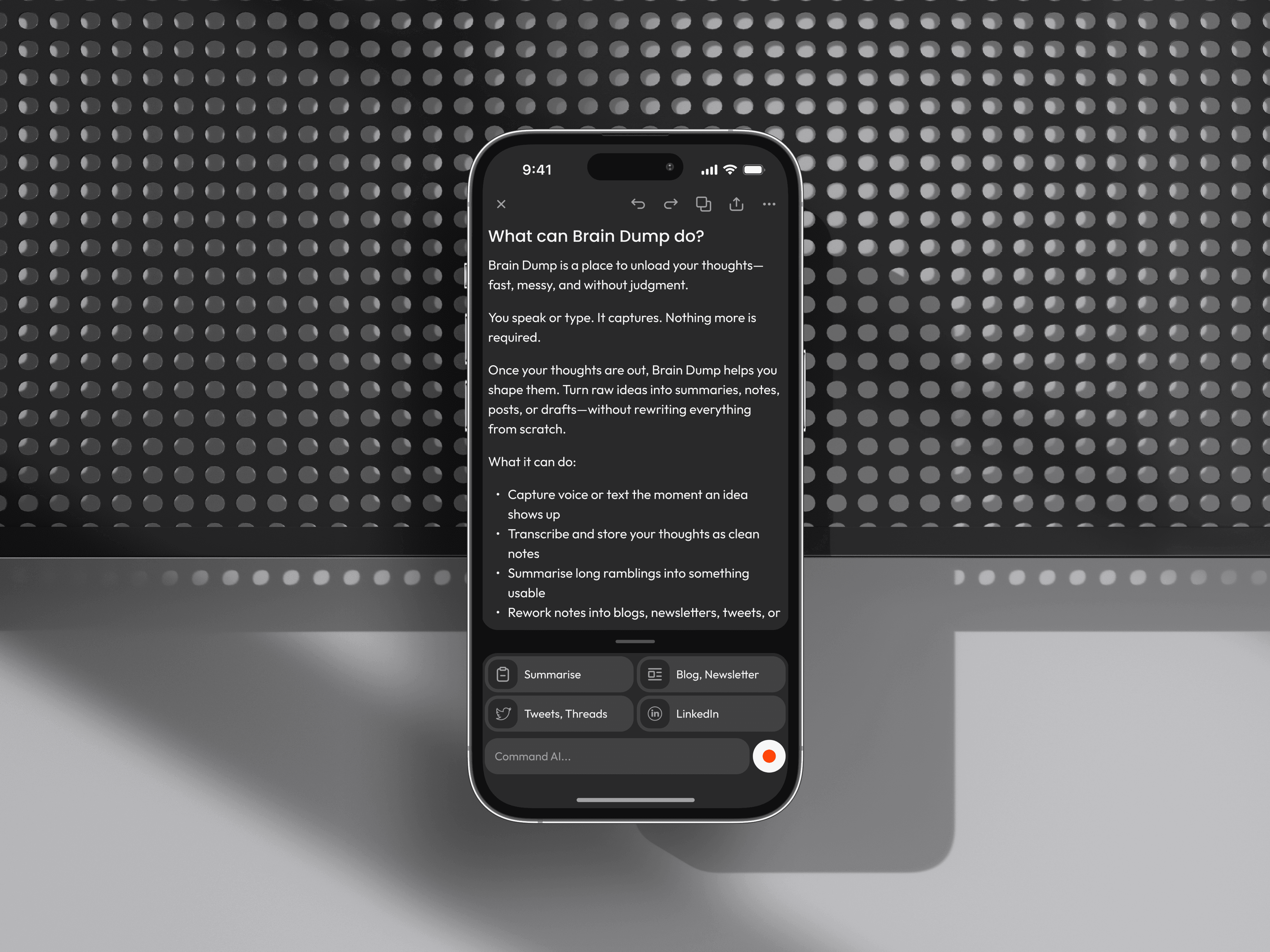
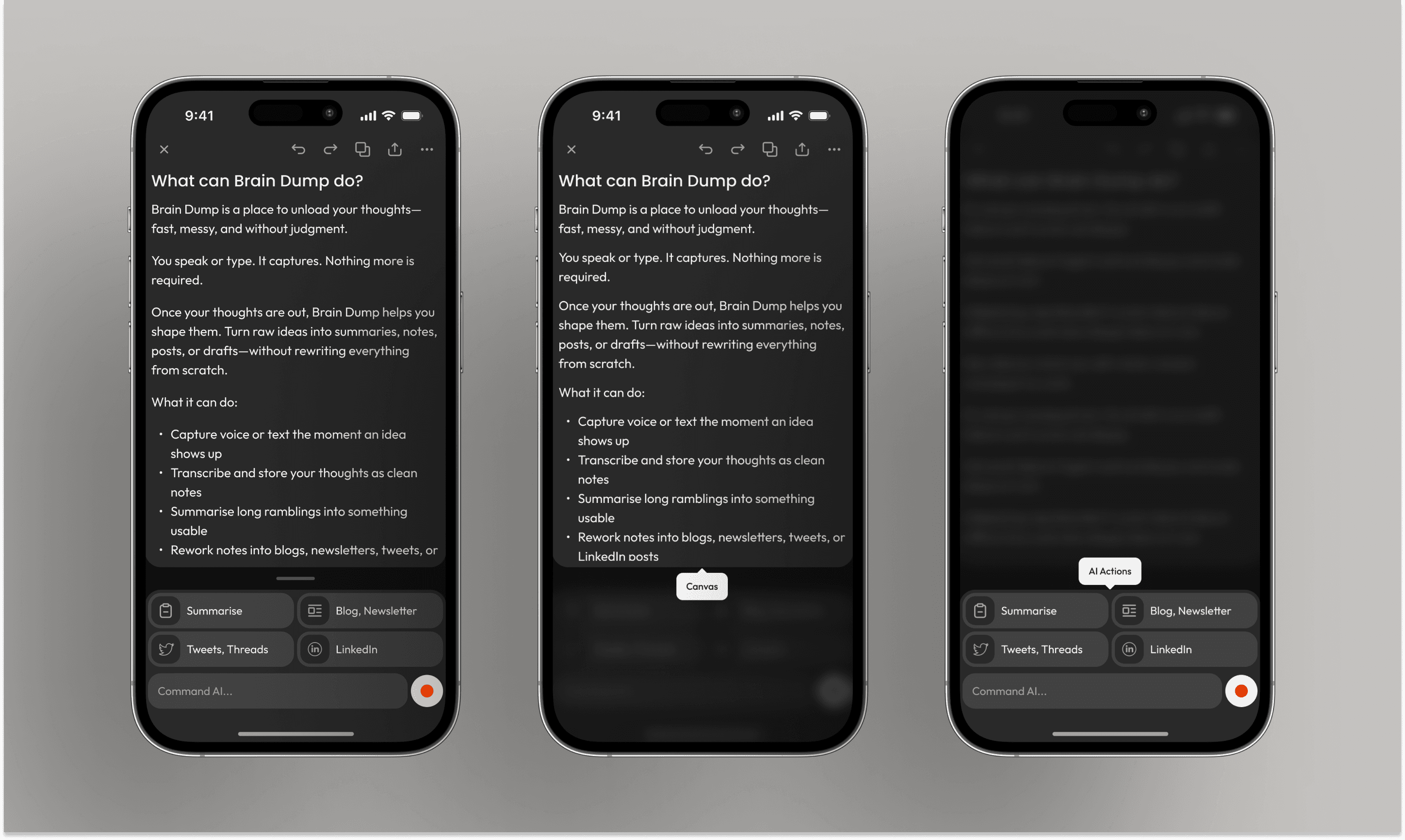
On a human level: the Note is split into the note itself, and a contextual AI action panel. This collapses the capture → refine → edit loop into a single surface—no navigation, modals, or mode switches.
Net effect: faster iteration with less friction.
A single surface for capture and refinement
On a human level: the Note is split into the note itself, and a contextual AI action panel. This collapses the capture → refine → edit loop into a single surface—no navigation, modals, or mode switches.
Net effect: faster iteration with less friction.
Contextual, not conversational AI
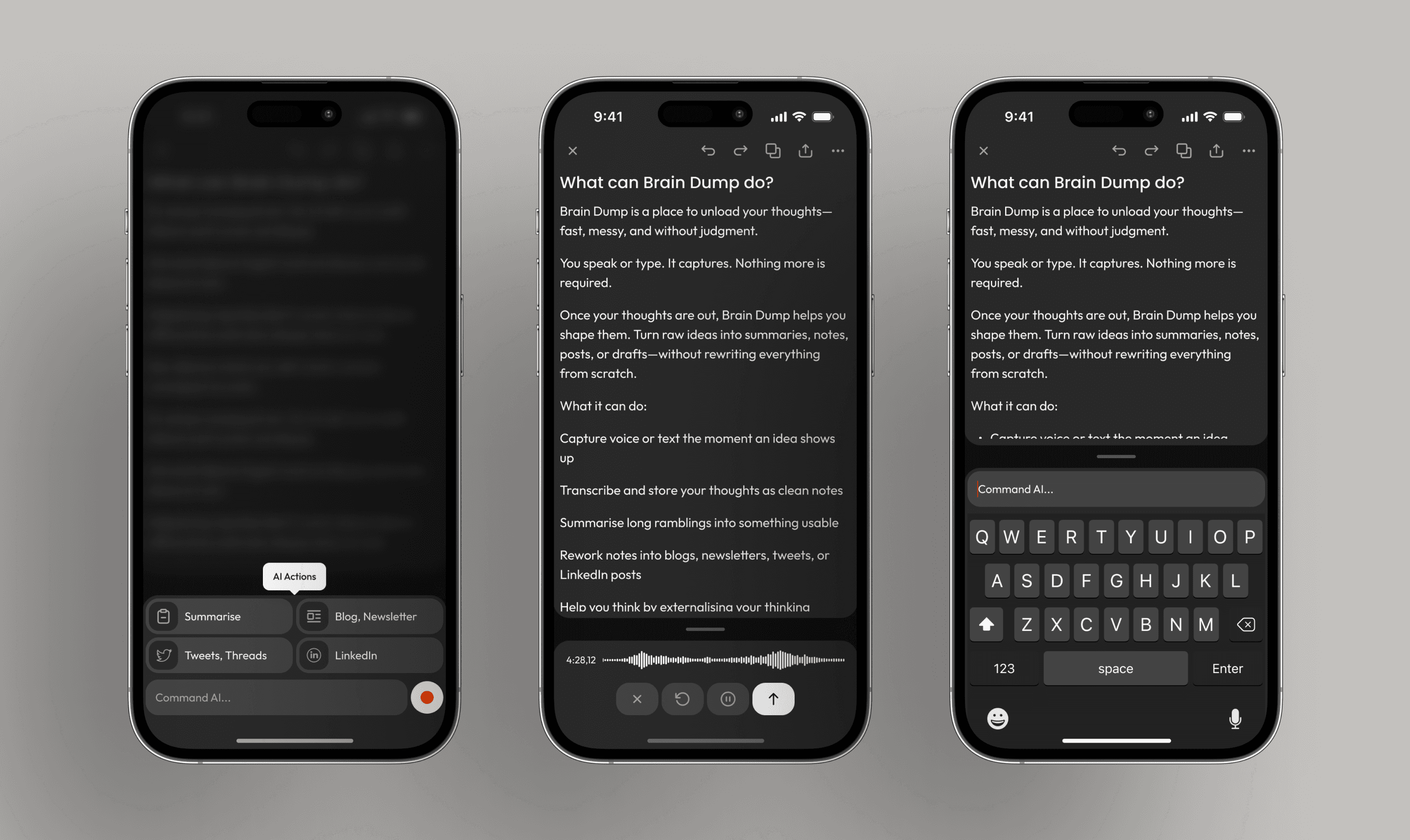
AI interactions are deliberately presented as actions applied to content, not as an open-ended chat. The bottom action panel exposes a small set of clear affordances—summarising, restructuring, or repurposing—without requiring prompt writing or tool setup. This keeps the AI secondary to the act of writing, activating only when refinement is needed.
Crucially, each action operates only on the active note. The model sees exactly what the user sees—nothing more. This keeps inputs explicit and limited, improving response relevance and keeping interactions fast.
Contextual, not conversational AI
AI interactions are deliberately presented as actions applied to content, not as an open-ended chat. The bottom action panel exposes a small set of clear affordances—summarising, restructuring, or repurposing—without requiring prompt writing or tool setup. This keeps the AI secondary to the act of writing, activating only when refinement is needed.
Crucially, each action operates only on the active note. The model sees exactly what the user sees—nothing more. This keeps inputs explicit and limited, improving response relevance and keeping interactions fast.
System clarity enforced by layout
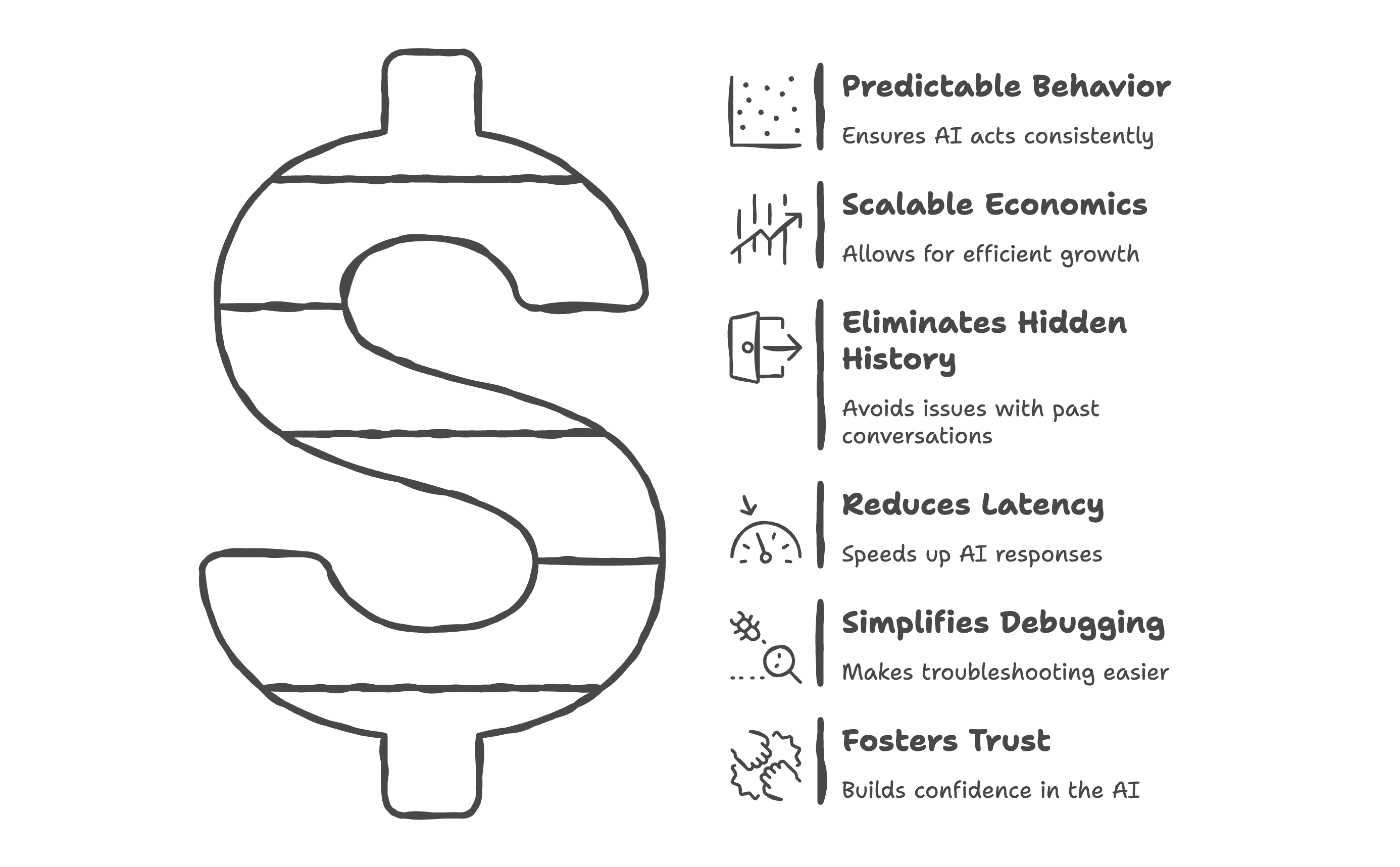
This structure is not just a UX decision; it is a system one. By tying AI actions directly to the visible note, the design prevents context from accumulating invisibly across interactions. Without growing conversational history, latency stays low, token usage and cost remain predictable, and system behavior is easier to reason about.
When something goes wrong, there is no ambiguity about what the model saw or why it responded the way it did. The UI makes system state explicit by design, simplifying failure diagnosis and ongoing iteration.
Net effect: predictable behavior and scalable economics.
System clarity enforced by layout
This structure is not just a UX decision; it is a system one. By tying AI actions directly to the visible note, the design prevents context from accumulating invisibly across interactions. Without growing conversational history, latency stays low, token usage and cost remain predictable, and system behavior is easier to reason about.
When something goes wrong, there is no ambiguity about what the model saw or why it responded the way it did. The UI makes system state explicit by design, simplifying failure diagnosis and ongoing iteration.
Net effect: predictable behavior and scalable economics.
Why this solution works
The final design balances human and system needs without compromising either. Users get a fast, low-cognitive-load way to capture and shape ideas, while the underlying system remains constrained, debuggable, and efficient. By letting layout enforce both interaction flow and system boundaries, the product avoids the fragility that often accompanies more “magical” AI experiences.
The result is a tool that stays out of the way when ideas are forming, and becomes powerful only when refinement is needed.
Why this solution works
The final design balances human and system needs without compromising either. Users get a fast, low-cognitive-load way to capture and shape ideas, while the underlying system remains constrained, debuggable, and efficient. By letting layout enforce both interaction flow and system boundaries, the product avoids the fragility that often accompanies more “magical” AI experiences.
The result is a tool that stays out of the way when ideas are forming, and becomes powerful only when refinement is needed.
Impact & Metrics
Coming soon
This product is currently in active beta with over 100 early users. Content released during development has generated 500k+ impressions to date. A public launch is planned soon, with full metrics to follow.
Coming soon
This product is currently in active beta with over 100 early users. Content released during development has generated 500k+ impressions to date. A public launch is planned soon, with full metrics to follow.
READY TO COLLABORATE?
READY TO COLLABORATE?
READY TO COLLABORATE?
Have some work in mind?
Have some work in mind?
Let’s create something extraordinary together
Let’s create something extraordinary together